When you buy through links on our articles, Future and its syndication partners may earn a commission.

Scientists using the world's most powerful solar telescope say they've finally observed small-scale magnetic twists on the sun — a discovery that may help solve the longstanding mystery of how the sun's atmosphere grows hotter the farther it extends from the surface.
The finding, based on data from the Daniel K. Inouye Solar Telescope in Hawaii, marks the first direct evidence of tiny twisting magnetic motions of energy-packed plasma waves in the sun's outer atmosphere, or corona, known as torsional Alfvén waves.
First predicted by Swedish Nobel laureate Hannes Alfvén in 1942, Alfvén waves are magnetic disturbances that travel through the plasma, the superheated, electrically charged gas that makes up the sun. Larger versions of these waves have been seen before, typically linked to solar flares, but the smaller, ever-present twisting kind had remained elusive — until now.
"This discovery ends a protracted search for these waves that has its origins in the 1940s," Richard Morton, a professor of engineering, physics and mathematics at Northumbria University in the U.K. who led the study, said in a statement.
Scientists have long suspected that these small-scale waves could continuously carry energy from the sun's surface into its atmosphere, powering the solar wind and heating the corona to millions of degrees, far hotter than the sun's visible surface, which is only about 9,932 degrees Fahrenheit (5,500 degrees Celsius).
The results offer crucial confirmation for theoretical models about how magnetic turbulence carries and dissipates energy in the sun's upper atmosphere, Morton added. "Having direct observations finally allows us to test these models against reality."
To arrive at their conclusions, Morton's team used data from the Inouye Telescope, which captures the highest-resolution images of the sun ever obtained. The four-meter-wide telescope can detect faint shifts in light that reveal how plasma moves through the corona, allowing scientists to see the sun in unprecedented detail.
During the telescope's commissioning phase in October 2023, the team tracked iron atoms heated to 1.6 million degrees Celsius and spotted faint red and blue shifts on opposite sides of magnetic loops, which were the telltale signature of twisting Alfvén waves, according to the study.
These waves twist the sun's magnetic field lines like a corkscrew, but the motion is too subtle to spot directly in images, scientists say. To detect them, Morton's team used spectroscopy, a technique that measures how hot gas moves toward or away from Earth. This motion slightly changes the light's color, red when moving away, blue when moving closer, thereby revealing the hidden twisting pattern in the sun's atmosphere.

"The movement of plasma in the sun's corona is dominated by swaying motions," Morton said in the statement. "These mask the torsional motions, so I had to develop a way of removing the swaying to find the twisting."
The results show that even in the sun's calmest regions, the corona is riddled with torsional Alfvén waves. These torsional Alfvén waves constantly turn the sun's magnetic field lines back and forth, carrying energy upward through its layers. These waves transport energy from the lower atmosphere into the corona, where it's released as heat, offering new insight into why the sun's outer atmosphere is millions of degrees hotter than its surface.
For Morton and his colleagues, the long-sought detection opens new potential investigations into how these waves propagate and dissipate energy in the corona.
A paper about these results was published on Oct. 24 in the journal Nature Astronomy.
LATEST POSTS
- 1
 Huge Iranian missile fragments, intercepted by air defenses, lay scattered across Israel, West Bank
 - 2Merz postpones Norway trip for Belgium talks on frozen Russian assets
- 3Doctor's orders: Eat ice cream, and other tips for a long and healthy life
- 4Venus shines at its best in spring and summer 2026 — here's what to look for
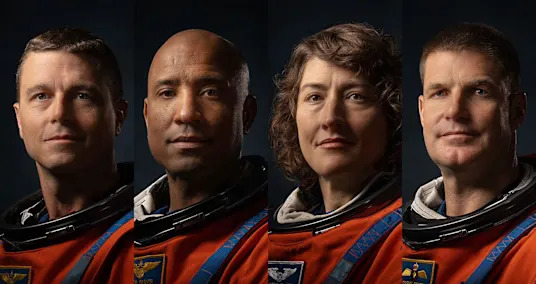
- 5These four astronauts could soon travel farther from Earth than anyone has gone before




- People who talk with their hands seem more clear and persuasive – new research
- Merz: 80% of Syrians in Germany expected to return within three years
- Genetic study identifies earliest-known dog, dating to 15,800 years ago
- What is IDF's view on pontential long-term occupation of southern Lebanon?
- Parents who delay baby's first vaccines also likely to skip measles shots
- Watch interstellar comet 3I/ATLAS make its closest approach to Earth in free livestream on Dec. 18
- New trailer for 'Bridgerton' Season 4 teases Benedict's love story: Watch it here
- Volkswagen Just Built a Plug-In Tiguan for China That America Doesn’t Get
- Figure out How to Keep up with and Clean Your Brilliant Bed for Ideal Execution